Continued from previous column…
Dance sequences are integral aspects of Indian cinema that allow filmmakers to expand their creative canvas while fulfilling the audience’s need for an escape from a dramatic plot. Three magic words: “dream sequence song” whisk viewers away from an Indian city to the Pyramids of Giza or the Alpine mountains. During that short sequence, regardless of what characters they’re playing, the actors are shown romancing each other in designer finery amidst world-class monuments before being returned to the world of the film at the end of the song. Dance songs have often surpassed the budget of an entire Bollywood film (like ‘Pyar Kiya Toh Darna Kya’ from Mughal-E-Azam) and directors are known to pull out all stops to fulfill the need of a song. A five-minute dance sequence is taken utterly seriously because when the visuals and music seep into the consciousness of the audience, one song has the ability to make the entire film more identifiable.

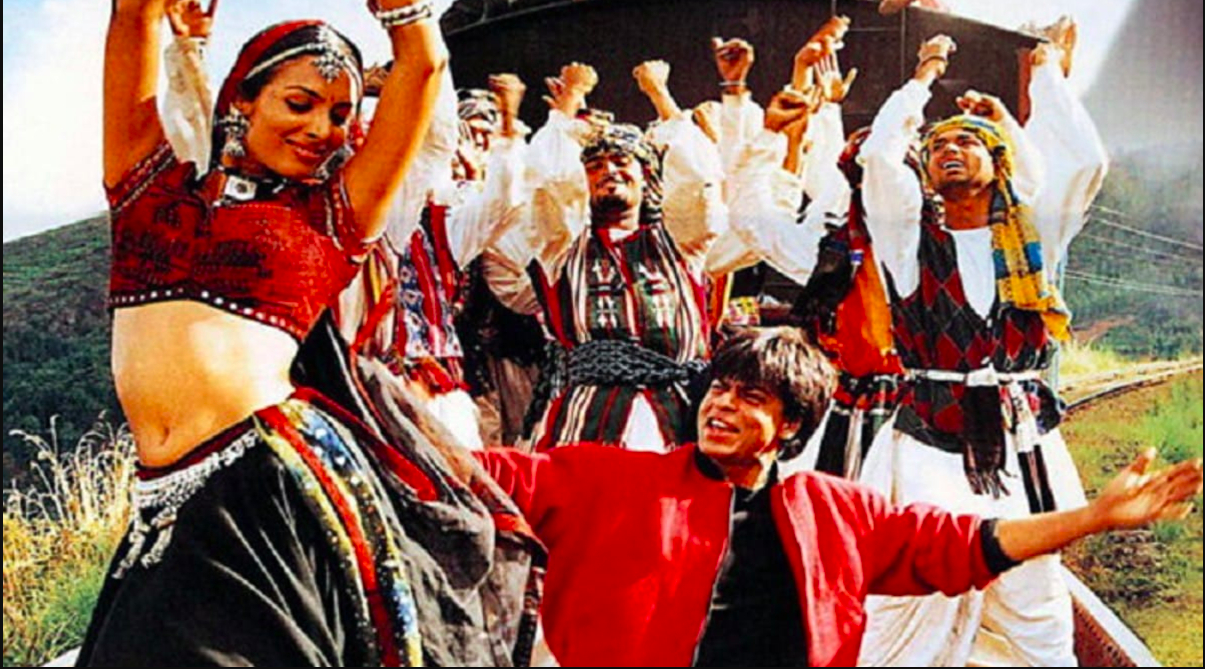
‘Chaiyya Chaiyya’, a song from the 1998 film, Dil Se was featured in an international poll conducted in 2002 by the BBC World Service of ten most popular songs of all time (‘Chaiyya Chaiyya’ stands at no. 9, beating ‘Bohemian Rhapsody’ at no. 10). The groovy rhythm of the song mimics the metronomic movement of the train and was even filmed atop a moving train. The sequence appears in the film when the male lead, Amarkant Verma, played by superstar Shah Rukh Khan, meets a stranger at a railway station on a stormy night and gets besotted by her. The song follows his journey on the train and features him dancing with a group of traveling musicians and dancers.
‘Chaiyya Chaiyya’ was originally intended to be shot at the Ooty railway station, but when the makers couldn’t get permission to shut the platform for four hours, the director Mani Ratnam and choreographer Farah Khan decided to shoot the song on a moving train. The crew got an alternate track between the rolling hills of Ooty and Coonoor and a separate train to to shoot on for four days. The dancers had rehearsed only on the studio floor but took on the tough challenge of dancing on a train that passes through tunnels and starts and stops at random since it was a narrow-gauge steam engine. At the time, in the absence of microphones and walkie talkies, the choreographer used a white cloth and hoisted it up as a signal to alert the dancers of an approaching tunnel so that they could duck down. Many audiences may not have watched the movie Dil Se, but the costumes, cinematography and dance movements of ‘Chaiyya Chaiyya’ are etched in the mind of every viewer that has even a cursory knowledge of Bollywood.
A rhythm of our own
Watching movie stars dance in synchronicity with hundreds of backup dancers creating an infectious vibe on-screen is a magical experience. Over the years, with choreographed hook steps and catchy rhythms, Bollywood dance has created a space for viewers to copy and recreate the dance moves. I grew up in the suburbs of Mumbai city where we live in housing societies or apartment buildings. Each housing society has anywhere between 50-200 apartments and the idea is that we’re all part of one collective.
To facilitate a constant social interaction between all the neighbors, residents of these housing societies organize festivals, cultural events and talent shows where a temporary stage is built in the compound and a sound system is hired. The most common acts at these events include kids performing dances to popular Bollywood songs in their own style. Painstakingly choreographing, practicing and performing our own Bollywood dances at these cultural events in front of our neighbors and friends was a big part of my childhood. It’s a great way for young kids in Indian cities to get over their stage fright. At schools too, teachers help students prepare dances for annual celebrations and the songs are often chosen from Bollywood’s vast oeuvre of melodies ranging from slow-tempo to fast-paced rhythms.
Another function that Bollywood has come to serve is to provide music for pre-wedding parties. In India, the sangeet is now a much awaited event that precedes the wedding day and comprises family members and friends performing choreographed Bollywood dance routines on stage in front of their relatives. As a result, Bollywood music composers try to create songs that might become the wedding favorite of that season. Songs such as ‘London Thumakda’, ‘Gallan Goodiyan’, ‘Ae Meri Zohrajabeen’, ‘Gal Mithi Mithi Bol’, ‘Sadi Gali’, ‘Mehendi Lagaa Ke Rakhna’, etc have become staples at Indian wedding parties.
Last summer, I was invited by dear friends living in New York City to DJ their wedding party. The guests comprised South Asians from Bangladesh, Germany, Trinidad and Tobago, India as well as first-generation South Asians born in the US. I was surprised at how the Bollywood chartbusters on my playlist were familiar to everyone and acted as the unifying force for all of us to collectively enjoy dancing to.
The streamlined format of choreographed Bollywood songs, combined with the audience’s penchant for mimicking the dance moves has created an industry of dance reality shows that exploded in the early 2000s. Dance reality shows are some of the highest-rated programs on Indian television. The most appealing aspect of these shows is the fact that a person of limited means living in an obscure town or village in the country can dance their way to fame and opportunities. There are countless rags-to-riches stories of contestants that built an organic following on the shows and have now established themselves as choreographers and actors in show business.
Bollywood dance rightfully stands on its own as a genre and still goes well beyond that. As an Indian living overseas, when I happen to hear a Bollywood song at a store or restaurant, my ears instantly perk up and the visuals of the song start to appear in my mind’s eye. The word ‘magic’ is often used to describe Bollywood song and dance. If that’s what the makers are going for, I’m sure that it’s working and spreading very well.
This article appeared in the July 25th issue of Brattleboro Reformer, Bennington Banner and Manchester Journal.