Starting today, July 27, 2023, I will be writing a monthly column on Indian cinema for the local newspapers in Vermont, Brattleboro Reformer, Bennington Banner and Manchester Journal. It feels great after a decade of writing commissioned articles for publications to finally write opinion pieces on subjects that I feel strongly about. The column is intended as a deep dive into the various aspects of Indian cinema. The first column is about the history of films in India and the fascinating details of how the first motion picture, Raja Harishchandra came into being. Read the full piece below:
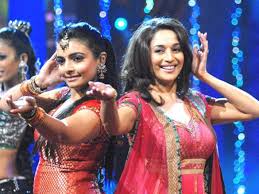
Photo provided by Bollywood Hungama
Vidhi Salla: An introduction to Indian cinema
The word “Bollywood” conjures up a colorful tableau of people in vibrant costumes dancing in synchronicity, romantic lovers mouthing dramatic dialogues, the virtuous hero beating up the bad guys and music that pervades all of the above.
I’m a journalist from Mumbai, now residing in New England. Film has been both a part of my life and — after a decade of writing about it and hosting a Bollywood radio show and specially curated movie events — an inseparable part of my identity. In my radio show and movie events, I share information that I have gathered over several years, interviews with film personalities as well as the socio-economic, political and cultural milieu around a specific film or theme. This is the first of a monthly column that I will be writing as a deep dive into the world of Indian cinema with a focus on Bollywood, films made in the city of Mumbai (earlier known as Bombay) in the Hindi language.
Bollywood and India
India is a land of diversity wherein the different states have their own regional language, cuisine, culture and customs that vastly differ from each other. What binds the whole country together is the people’s love for cinema. Indian cinema, too, like the land, comprises films made in several regional languages such as Tamil, Telugu, Malayalam, Bengali, Marathi, Gujarati, Assamese, Bhojpuri and so on. The dominant industry that overshadows them all is that of films made in Hindi, a language spoken by more than 50% of India’s population along with a combination of Urdu; and because the industry originated in the city of Bombay, it earned the name Bollywood — a portmanteau of Bombay and Hollywood
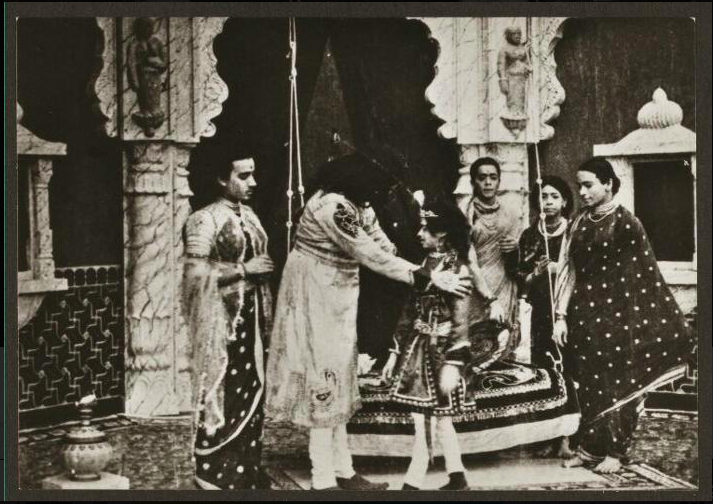
Photo via New York Public Library
How it all began
The first Indian film was “Raja Harishchandra,” made in 1913, based on the life of an honest and virtuous king, Harishchandra and his wife, Taramati. It was a silent film directed by Dhundiraj Govind Phalke, better known as Dadasaheb Phalke, the father of Indian cinema (for those interested, “Harishchandrachi Factory” (2009) is a wonderful biopic in Marathi on his life and the making of the first Indian film). The story goes that on Easter day in India, Phalke went to watch a film called “The Birth, the Life and the Death of Christ” (1906) directed by Alice Guy-Blaché at the America India Picture Palace in Bombay. A trained visual artist, printer, sculptor, amateur magician and photographer, Phalke imagined the “moving pictures” with Hindu mythological characters narrated in the same style as the story of Christ. Thereafter began his journey of becoming the first Indian feature filmmaker, creating the first indigenous Indian motion picture. He filmed “Raja Harishchandra” inside his own bungalow with foreign equipment and local labor.
The early 1900s was not a time when women were seen in public spaces. Phalke’s search for his film’s female lead turned out to be futile until he noticed a slender man with effeminate arms working as a cook/waiter at a local restaurant he frequented. It was common in Indian society for men to play women’s roles in plays, and so, Anna Hari Salunkhe became the first Indian actor to play female roles in films and later established himself as a cinematographer.
In 1931, India’s first talkie, “Alam Ara,” was released, by which time, the country had produced almost 100 silent films, most of them social or mythological dramas. “Alam Ara” was made by Ardeshir Irani, the first Indian representative of Universal Studios who produced a handful of silent films before venturing into the world of talkies. He was inspired by the American film, “Show Boat” (1929) that was a 40 percent talkie. Multiple reviews of “Alam Ara” after its release criticized the sound recording quality of the film and the actors’ inability to talk directly into the microphones, proving why it was so arduous to make a talking film. That did not deter mobs of audiences from queuing up outside the theaters for several hours to buy the tickets. The film also pioneered the trend of songs and dances that became an inseparable part of Indian films.
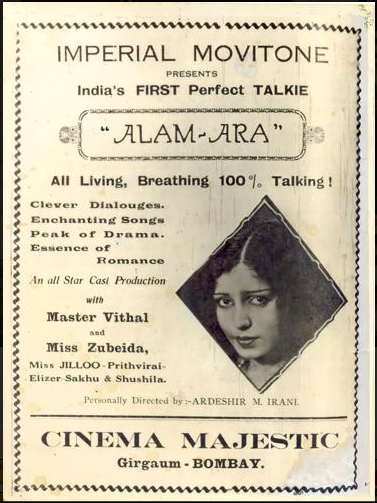
Image provided by Imperial Film Company
Current scenario
As of 2022, Bollywood constituted 33 percent of the world’s movie market in comparison to Hollywood’s 12 per cent. The revenue from Indian films was estimated at $1.28 billion in 2022 with an audience of about 3 billion worldwide. Bollywood produces an average of 1,000 movies in a year compared to 500 movies produced by Hollywood for a global audience of 2.6 billion viewers. Statistics aside, it is the open invitation to escapism, the colorful mosaic of multiples genres and themes, often within one film, unabashed deviations from the plot to indulge in song and dance that have earned Bollywood billions of fans worldwide that only keep increasing every year. Bollywood music and dance that began as tools for entertainment have become genres unto themselves.
In next month’s column, I will write about the Bollywood music industry and the unique field of playback singing that it gave rise to.
Vidhi Salla is an independent cultural arts curator based in Guilford. The views expressed in this column are the author’s own. More information can be found on vidhiism.com. Vidhi’s radio show, Vidhi’s Bollywood Jukebox is live every Thursday from 3 to 5 p.m. and can be streamed worldwide via wvew.org.
Original source: https://tinyurl.com/vidcol1