On June 7, during Gallery Walk in downtown Brattleboro, I was invited to DJ and lead a group of revelers to some Bollywood dance as part of the multicultural fest organized by the Ethiopian Community Development Center (ECDC). There was enthusiastic participation from the crowd, and it was most heartening for me to watch the people standing on the sides slowly drop their inhibitions and join the dancing. It was a high-energy dance party that represented everything that Bollywood dance has come to symbolize: communal, unabashed, vibrant revelry. Bollywood dance with its universal appeal encompasses several national and global influences, but the main quality it holds is that of inclusivity.
It is designed to invite viewers to participate and mimic the moves to the best of their ability and the only skill required is that of complete enjoyment. Bollywood dance is a popular phenomenon that has now reached global recognition. In this two-part article, I will expand on the various characteristics and appeal of Bollywood dance along with sharing information about some iconic dance numbers that have shaped the course of dance in Indian films.

What is Bollywood dance?
Bollywood is the moniker given to Indian films made in the Hindi language. The name is a fusion of Bombay city, where the Indian film industry originated, and Hollywood. The history of Indian films is rooted in Parsi theater, which comprised courtly romances and historical costume dramas enacted with live music and dance. Right from India’s first talking film, Alam Ara (1931), music and dance cemented themselves as staples of movie narratives.
Drawing from centuries-old traditions of North and South Indian classical music as well as classical dance forms such as Kathak and Bharatanatyam, song and dance in Indian films became tools of expression and entertainment designed to make the experience more memorable for audiences. Over the years, the dancing style in Indian films has borrowed from several global influences including hip-hop, salsa, flamenco, contemporary, jazz, break dance and bebop but in its final desi-fied version, customized for the Indian viewer, it can best be described as Bollywood dance.
One of the chief characteristics of Bollywood dance is a series of moves that allude to the lyrics of the song. For example, if the song describes someone’s kohl-lined eyes, the corresponding dance moves will highlight the eyes by pointing to them, or defining them by placing the first two fingers horizontally over the the top and bottom of the eye, like in the song “Kajra Re” from the film Bunty Aur Babli (2005). For a song about a beating heart, the dance moves will involve some cool chest-thumping steps: the most popular example being, “Dhak Dhak Karne Laga” from Beta (1992).
Dance numbers act as narrative tools, fillers or advertisements; often, they’re created in the style of a music video to market the film better. Every upcoming film’s dance numbers are played frequently on television, radio and social media, the idea being that irrespective of the film’s plot, the songs will ensure that the film stays in the memory of the audience and result in ticket sales. I’m guilty of watching several bad films in the theaters simply to see a catchy dance number on-screen featuring my favorite actor or actress.
Over the years, Bollywood dance numbers have become high-budget extravaganzas and often surpass the success of the film itself. A lot of their success has to do with hook dance steps that choreographers create to establish the core theme of a song. The idea of a Bollywood dance number is not only to entertain people but also to encourage audiences to copy the moves and entertain themselves or the people around them. Therefore, having an identifiable, catchy hook step (think Macarena) that can be easily recreated at a dance party becomes a universal language with which to commune with other Bollywood dance fans.

Professional choreography and iconic dances
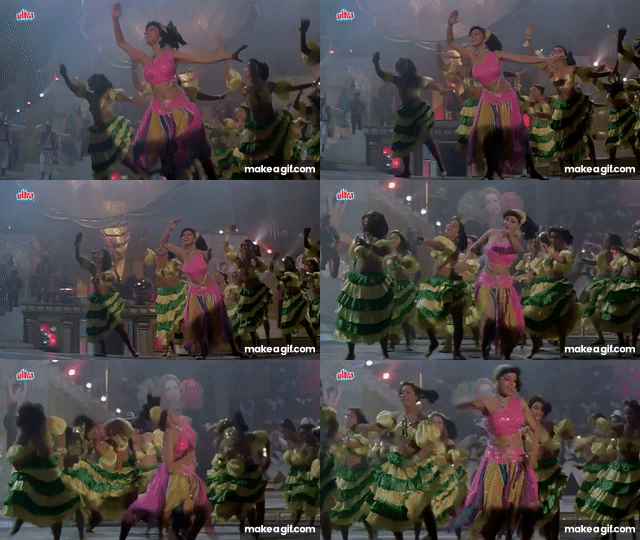
Bollywood’s most famous awards, Filmfare, were established in 1954 by a best-selling movie magazine of the same name. It wasn’t until 1989 that an award category for best choreography was created. The reason for the creation of this award category was one iconic song that took the entire nation by storm: “Ek Do Teen” from the film Tezaab (1988). It was the first dance number of Madhuri Dixit, the superstar dancing diva of Bollywood. The song’s snappy lyrics comprise counting numbers in Hindi: “ek do teen char paanch che saat aath nau … (one, two, three, four, five, six, seven, eight)” going up to 30, as the female character describes how many days of the month she has been waiting to hear back from her love interest.
Choreographer Saroj Khan directed the dance moves and a hook step where Dixit depicts how she’s doing the intezaar (waiting) for her beloved: her right hand shielding her forehead, like when you look for someone in the distance, and hopping in backward motion while shaking her hips to the beat.
“Ek Do Teen” appears in the film as a stage performance with seven costume changes, about 50 backup dancers and continuous high-energy dance moves. The song’s final shooting took place inside a studio in front of a real audience of 1,000 people. As Dixit performed the dance and the hook step, the audience went screaming and ripping their clothes off, waving them at her in an outburst of excitement.
When Tezaab was released in theaters, audiences demanded the projectionists to replay “Ek Do Teen” several times mid-screening and threw coins at the screen in exhilaration. This one song established Saroj Khan as the ultimate Bollywood choreographer (she won the maximum awards for best choreography throughout her career), catapulted Madhuri Dixit to superstardom in the 1990s and created an idiom for Bollywood dance that was followed, perfected and enhanced in the years to come.
In next month’s column, I will share more stories of iconic dance numbers including “Chaiyya Chaiyya,” the only song to be choreographed atop a moving train.